Salzburg Festival 2026Europa
Wajdi Mouawad | Krzysztof Warlikowski
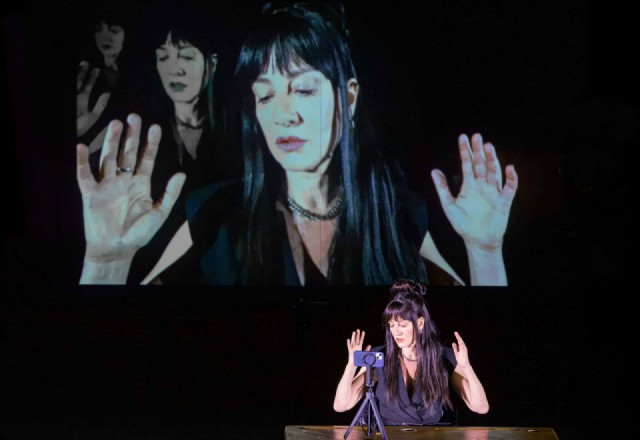
‘The journey back home is always a journey, but never truly a return.‘
Silence – crimes left unspoken.
Trauma’s legacy resurfaces across generations. Wars, genocide and the massacre of civilians proceed without pause. The world falls silent at the sight of yet another, even more brazen crime – then forgets. Life goes on; impunity prevails, inviting further killers to act.
In his theatre, Krzysztof Warlikowski probes responsibility and guilt, tracing modern conflicts back to Greek tragedy. Taking up a text by one of his emblematic authors – Europa’s Pledge by the European Prize for Dramaturgy laureate Wajdi Mouawad – he widens his field of inquiry to territories shaped by inherited trauma. Here the darkness seizes us all: without exception we are entangled in traumatic events, whether on the side of victims or of perpetrators. Even if we took no direct part in those dramas, guilt descends on us like a curse; it leaves its mark.
Every contemporary massacre is woven into a primordial order of killing that reaches back to mythic times. It summons the violent myths of the gods – divine acts of rape bound to desire for the human body – that underwrite those narratives.
Now imagine old Europe – at times awash in blood, at times observing from a distance the abattoirs unfolding across the world. Can you really feel innocent? And remember: you are accountable for what you feel.
Krzysztof Warlikowski, known for productions that interweave ancient material with contemporary themes, has recently caused a stir with his opera interpretations in Salzburg. Now he is making his debut as a theatre director at the Salzburg Festival, staging Mouawad’s latest drama with the ensemble of Warsaw’s Nowy Teatr, which he has directed since 2008.
The author, director and actor Wajdi Mouawad, born in Lebanon in 1968, has been director of the Théâtre national La Colline in Paris since 2016. He is internationally regarded as one of the most renowned playwrights. His plays deal with the collective legacy of violence and war, the repression of history, traumatic experiences and the search for identity, often against the backdrop of his own biography and the great myths. ‘My relationship with tragedy goes back a long way,’ he says. ‘It was through tragedy that my desire to make theatre was born, and most of the plays I have written stem from reading ancient tragedies. If one were to imagine the great authors – Shakespeare, Chekhov, Beckett – as gardens, Sophocles would be the one in which I feel most at home. I return to him again and again. My play explores, in my view, fundamental questions: the relationship between extreme violence and the possibility of consolation; the idea that words can be a site of conflict, but also of repair and revelation.’
After the play Europa’s Pledge (Le Serment d’Europe)